15+ years infrastructure and operations leadership
Infrastructure leader · problem solver · builder
Matt Smalling
Infrastructure Modernization, Automation & AI Operations
Head of Infrastructure & Cloud Operations | Infrastructure Modernization Leader | Building toward Platform Engineering & AI Infrastructure
Bridging traditional infrastructure and modern platform engineering to deliver resilient, automated, and intelligent systems.
Executive Snapshot
Infrastructure leadership with operational depth, modernization judgment, and current AI platform proof.
Head of Infrastructure & Cloud Operations experience
Hybrid cloud, virtualization, and enterprise modernization
Operational reliability, disaster recovery, and service delivery
SOC 1 / SOC 2 readiness, governance, and compliance alignment
Team leadership, vendor management, and stakeholder alignment
Current AI infrastructure and platform engineering lab work
Selected Work
Infrastructure, platform engineering, observability, and AI systems built from the ground up.
NovaLab AI Runtime Platform
Designs and operates a local AI infrastructure platform for model serving, observability, benchmarking, and future RAG and agent workflows using production-inspired engineering practices.
View Case StudyGenesis Kubernetes Platform Foundation
Builds a highly available K3s platform on Proxmox with a validated API VIP, layered etcd and Velero recovery, local S3-compatible off-node protection, and explicit persistent-data boundaries.
View Case StudyProject Azure Enterprise
Builds a Microsoft enterprise baseline for a 300-person organization, focused on Entra ID, Microsoft 365, SharePoint, Teams, Exchange, Intune, Conditional Access, Defender, governance, and cost-aware lab design.
View ProjectMicrosoft Endpoint Management Proof of Concept
A Windows 11 Enterprise proof of concept validating Microsoft Entra join, Intune policy delivery, BitLocker recovery, Defender security controls, and policy rollback through a controlled pilot endpoint.
View Case StudyBuilding a Local AI Infrastructure Platform
Converted an unstable AI lab environment into a validated, recoverable platform baseline on Proxmox with RTX 3090 GPU acceleration, Open WebUI, Ollama, and documented recovery controls.
View Case StudyBuilding a llama.cpp Runtime Platform
Built a dedicated llama.cpp runtime layer to understand GPU-accelerated inference, GGUF model operation, Open WebUI integration, and recovery-focused platform engineering practices.
View Case StudyChron0s Enterprise Time Architecture
Reduced infrastructure time-sync risk by turning a GPS-backed Raspberry Pi source into an enterprise-style hierarchy for identity, logging, security monitoring, backups, and core systems.
View Case StudyLifecycle Risk Reduction Program
Modernization example focused on aging infrastructure, service continuity, stakeholder alignment, phased execution, and keeping trust intact while systems change.
Discuss approachOperational Standards and Paved Paths
Platform practice example focused on repeatable standards, lower support variance, clearer handoffs, and higher team confidence across common infrastructure workflows.
Discuss approach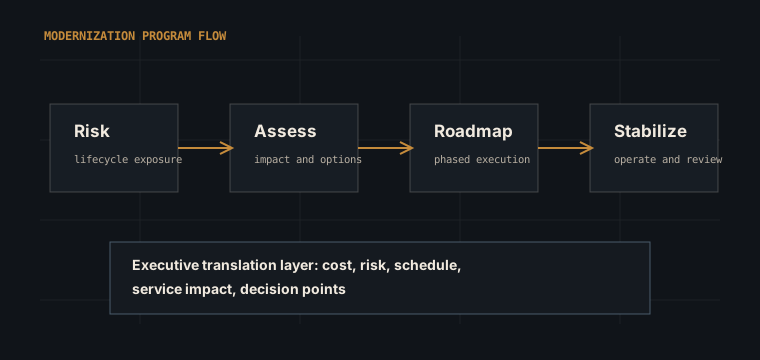
Leadership
Operational maturity is the foundation. Modernization is how it starts helping more people.
Modernization Roadmaps
Prioritizing infrastructure improvements by business impact, risk, lifecycle urgency, and the team's actual capacity to absorb change.
Operations Discipline
Building repeatable practices for incident response, escalation, maintenance windows, and service review, because calm is usually designed ahead of time.
Executive Translation
Turning technical risk, constraints, and options into plain decisions leaders can act on without pretending the tradeoffs disappeared.
What I Bring
Senior infrastructure work is technical, operational, financial, and human all at once.
Infrastructure Modernization Leadership
Roadmaps, lifecycle decisions, phased delivery, and modernization work that keeps service continuity and stakeholder trust intact.
Operational Excellence & Service Delivery
Reliable operations, incident discipline, recovery thinking, and service practices that help teams stay calm when systems matter.
Hybrid Cloud & Enterprise Infrastructure
Practical judgment across cloud, on-prem, virtualization, data center, and platform decisions based on workload fit and business risk.
Governance, Compliance & Risk Reduction
SOC readiness, documentation, controls alignment, and decision records that make infrastructure easier to trust, audit, and improve.
Team Leadership & Vendor Management
Clear communication, team enablement, vendor coordination, and executive translation that turn technical work into decisions people can act on.
AI Infrastructure & Platform Direction
Current hands-on lab work with local AI runtimes, GPU infrastructure, observability, recovery, and platform engineering patterns.
Leadership Through Learning
Teaching is part of the operating model, not a separate activity after the real work is done.
Leadership is not just assigning work and waiting for updates. For me, the best technical leadership happens when you are willing to get into the weeds with the team, learn alongside them, and then turn that learning into something repeatable.
Over the last several months, I spent time teaching my team through lunch-and-learns, informal walkthroughs, architecture discussions, and hands-on sessions. Some of it was planned. Some of it happened because a real problem showed up and we used it as a teaching moment.
The goal was simple: make the team stronger, more confident, and more capable of owning modern infrastructure work.
Lunch & Learns
Informal team sessions focused on practical infrastructure topics, lessons learned, and real-world troubleshooting.
Hands-On Infrastructure Training
Working directly through tools and concepts instead of only talking about them: Git, Terraform, Docker, Proxmox, AWS, observability, and automation.
Documentation as Teaching
Turning lessons, fixes, and project steps into guides, runbooks, and repeatable processes that others can follow.
Mentorship Mindset
Helping engineers understand the why behind technical decisions, not just the commands to run.
Learning in Public
Using the portfolio to show active growth across Git, Terraform, Docker, AI infrastructure, Proxmox, and platform engineering.
Current Learning Tracks
Active areas where personal learning turns into documentation, team conversations, and reusable practice.
- Git and GitHub workflow
- Terraform and Infrastructure as Code
- Docker and container fundamentals
- Proxmox infrastructure rebuild
- Chron0s Raspberry Pi GPS time server
- AI runtime platform and observability
- Kubernetes platform foundation
- Microsoft endpoint management proof of concept
- Platform engineering foundations
Matt's Notes
Learning out loud makes the team stronger.
I have never believed leadership means pretending to know everything. The better approach is to learn fast, be honest about what you are still figuring out, and bring the team along with you.
When I teach something, I usually understand it better myself. That is part of the reason I care about documentation, lunch-and-learns, and hands-on labs. They are not side quests. They are how teams get stronger.
Engineering Philosophy
The principles behind the way I build, modernize, and lead infrastructure work.
Build for operations, not demonstrations.
Technology only matters if it remains reliable, supportable, and useful after implementation.
Understand before you automate.
Automation should amplify good engineering decisions, not replace understanding.
Modernization should reduce complexity.
Every platform decision should make operations easier, not harder.
Stay close to the technology.
Infrastructure leadership is strongest when grounded in current technical experience.
Infrastructure is a business capability.
Reliable platforms enable people, products, and business outcomes.
As you move up the ladder, stay human. Otherwise, what is the point?
About
The throughline is not reinvention. It is taking the lessons from real operations and building better platforms with them.
Matt's path starts with the work that earns trust: keeping services stable, reducing infrastructure risk, communicating clearly when things are tense, and modernizing systems without forgetting the people depending on them. The work is technical, but the point is still human.
The next chapter builds on that foundation. Platform engineering and AI infrastructure are treated here as operating models, not trends: repeatable patterns, responsible automation, practical evaluation, and a bias toward systems that can be understood, supported, and improved by real teams on real days.
Leadership Mode
Calm, direct, and useful under pressure
Technical Direction
Platform engineering without the theater
AI Focus
Local LLMs, GPU nodes, honest evaluation
Career Evolution
A career moving from operational ownership toward platform and AI infrastructure, one practical step at a time.
Infrastructure Operator
Built credibility by showing up for production systems, service continuity, incident work, and the unglamorous details that keep trust intact.
Modernization Lead
Shifted from reacting to problems toward roadmaps, lifecycle risk reduction, stakeholder alignment, and phased delivery people could actually follow.
Platform-Minded Leader
Focused on standards, paved paths, support models, automation opportunities, and the kind of patterns teams are relieved to reuse.
AI Infrastructure Builder
Using a local lab to learn GPU constraints, model-serving workflows, evaluation loops, and what breaks when the demo becomes a system.
Modernization
Infrastructure decisions are rarely about cloud versus on-prem. They are about judgment.
Matt brings deep infrastructure operations experience into the platform and AI infrastructure transition: data center operations, hybrid environments, virtualization platforms, cloud environments, security, backups, recovery, and modernization work where the wrong decision shows up later as risk, cost, or lost trust.
The useful answer is not always "move it to the cloud" or "keep it local." It depends on the workload, the business, the data, the people operating it, and the consequences if it fails. VMware, Hyper-V, Proxmox, AWS, on-prem systems, cloud systems, and odd out-of-the-box environments all have a place when they solve the right problem.
Protecting corporate intellectual property matters regardless of where the workload lives. Reliability, security, cost, maintainability, compliance, and business outcomes all need a seat at the same table. Platform engineering and AI infrastructure are the next evolution of that background, not a reset button.
Data CenterPower, space, hardware, lifecycle
VirtualizationVMware, Hyper-V, Proxmox
CloudAWS, managed services, delivery speed
ProtectionSecurity, backups, recovery, IP control
ModernizationRisk, cost, compliance, business fit
Workload Placement Model
Start with the workload and risk profile. Then choose the environment. Not the other way around.
On-Premises When
- Intellectual property must remain tightly controlled
- Regulatory or security requirements are strict
- Latency, cost, or operational control matter
Cloud When
- Elastic scale matters
- Managed services reduce operational burden
- Speed of delivery is more important than owning the stack
Hybrid When
- Sensitive systems need to remain local
- Cloud services can extend capability
- The business needs both control and flexibility
AI Infrastructure Lens
AI workloads should not automatically go to the cloud. Placement should depend on data sensitivity, cost, GPU availability, operational control, and business risk. The right answer may be local, cloud, or hybrid. The job is to know why.
Platform Engineering
Moving from individual system ownership toward repeatable internal capability teams can trust.
Platform Operating Layer
Standards, automation, paved paths
Golden Paths
Documented, repeatable patterns for deploying and operating services with fewer bespoke handoffs and fewer mystery rituals.
Service Ownership
Clear ownership boundaries, support models, escalation paths, and lifecycle accountability that people can explain without a meeting about the meeting.
Automation Backlog
Targeted reduction of toil across provisioning, monitoring, reporting, and operational checks, especially the work everyone quietly knows should not be manual.
NovaLab
A simple operating view of what is already running and what is queued for the next platform iteration.
AI needs an operating model
AI infrastructure work needs a controlled platform before it can become trusted enterprise capability. Model serving, observability, recovery, and future RAG/vLLM work need ownership instead of scattered experiments.
Build the lab as infrastructure
NovaLab is structured as a local AI runtime platform with active services, planned runtime expansion, and infrastructure-first patterns for model serving, observability, and recovery.
Clear service and roadmap view
The platform now has a visible operating view: active Open WebUI/Ollama services, RTX 3090 infrastructure, backup strategy, and planned vLLM, vector database, RAG, and AI operations work.
Less unmanaged AI sprawl
Treating AI workloads as infrastructure services reduces the risk of unclear ownership, weak recovery paths, unmanaged runtime choices, and decisions made without placement or observability context.
From experiments to platform practice
NovaLab turns AI learning into an operating roadmap: active services, planned capabilities, recovery thinking, and repeatable patterns that can be evaluated before broader adoption.
Operational
Active Services
- CoreAI Platform
- ComputeRTX 3090 Infrastructure
- InterfaceOpen WebUI
- RuntimeOllama
- ResilienceBackup Strategy
Planned
Planned Initiatives
- Runtimellama.cpp
- ServingvLLM
- Data LayerVector Database
- KnowledgeRAG Knowledge Platform
- AutomationAI Operations Agent
AI Infrastructure Lab
The lab is where infrastructure judgment meets AI platform reality.
Lab Thesis
AI infrastructure becomes real when you have to provision it, cool it, expose it, secure it, evaluate it, explain it, and keep improving it. This lab keeps the learning honest.
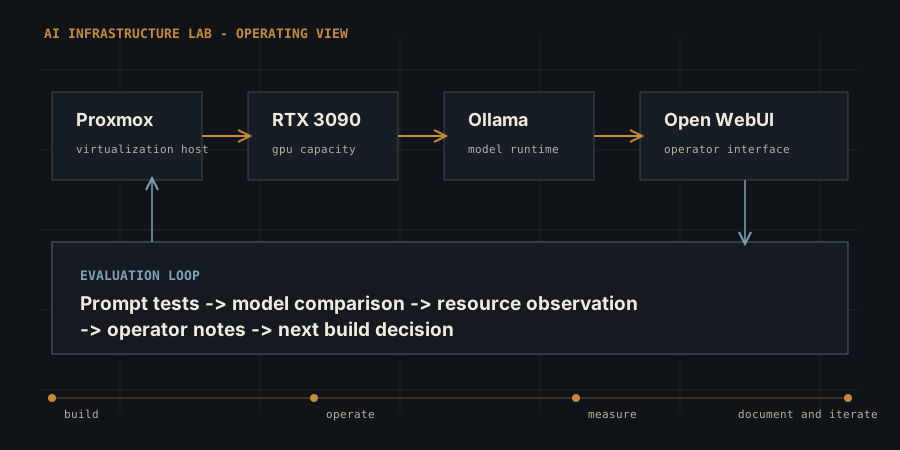
Lab Stack
Version 1
- ComputeProxmox AI Platform
- GPURTX 3090 GPU Infrastructure
- InterfaceOpen WebUI
- RuntimeOllama
- EvaluationLocal LLM Evaluation
- GrowthAI Learning Roadmap
Why It Matters
The lab turns AI infrastructure from reading material into operational practice: capacity planning, model lifecycle, deployment friction, observability gaps, and user-facing reliability. It is where the neat ideas meet the noisy machine.
Current Learning Tracks
GPU passthrough, local model serving, prompt and model evaluation, retrieval patterns, security posture, and the practical economics of self-hosted AI tooling.
Runtime Platform Case Study
The llama.cpp runtime platform extends the lab into GPU-accelerated inference, GGUF model operation, Open WebUI backend integration, and recovery-focused platform engineering.
View Case StudyInfrastructure Layer
Proxmox host design, GPU allocation, storage considerations, network segmentation, and rebuild notes that future Matt will appreciate.
Model Operations Layer
Ollama runtime patterns, model selection, resource observation, prompt behavior, and local serving constraints.
Experience Layer
Open WebUI workflows, user-facing reliability, practical access patterns, and usability tradeoffs.
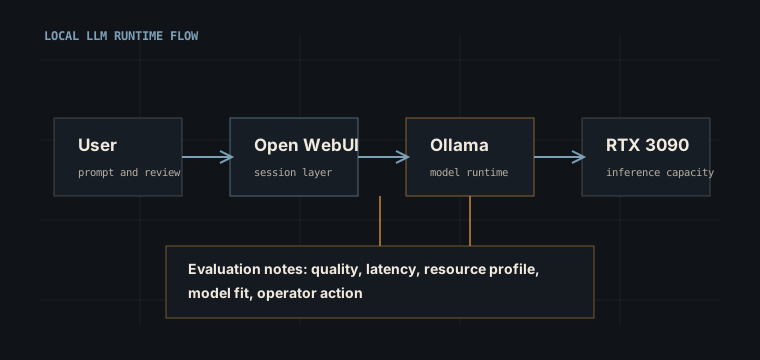
Evaluation Layer
Repeatable tests for quality, latency, context handling, hardware utilization, and fit for real operational use, not just a nice screenshot.
Current Initiatives
What I'm actively building, documenting, and learning.
NovaLab AI Runtime Platform
Operating a local AI runtime platform to validate inference workflows, GPU behavior, observability, and benchmark-driven performance decisions.
View Case StudyGenesis Kubernetes Platform Foundation
Engineering a highly available K3s foundation with tested API VIP failover, scheduled off-node backups, and destructive Kubernetes resource recovery.
View Case StudyProject Azure Enterprise
Building a Microsoft enterprise baseline for a 300-person organization before layering on advanced security controls.
View ProjectPlatform Engineering Journey
Turning infrastructure operations experience into repeatable platform patterns, delivery standards, and clearer ownership models.
View ProjectHomeLab Modernization
Modernizing the lab into a more enterprise-style environment with stronger networking, storage, monitoring, and automation foundations.
View ProjectLearning Journey
Keeping the portfolio current by documenting the learning tracks that connect AI infrastructure, Microsoft enterprise work, leadership, and platform engineering.
View Learning DashboardCurrent Initiatives
Current work is aimed at turning infrastructure experience into platform and AI execution, with receipts.
AI Platform Home Lab
Building and documenting a local AI platform with virtualization, GPU acceleration, model runtime, and enough notes to make the next rebuild less dramatic.
Platform Engineering Portfolio
Translating operations leadership into artifacts hiring teams can inspect: patterns, diagrams, case studies, and decision records written in plain English.
Local LLM Evaluation Practice
Comparing model behavior, resource requirements, usability, and operational fit instead of assuming the newest model is automatically the right answer.
Automation and Observability Backlog
Identifying the highest-value automation and monitoring improvements that would make the lab easier to run, explain, and hand to another human.
Learning Dashboard
Strategic development areas, tracked as an operating roadmap for platform and AI infrastructure.
Capability Vector
The current development focus is the systems layer behind dependable AI platforms: infrastructure as code, container operations, platform practices, protected configuration, retrieval patterns, and agent workflows that can be operated responsibly.
Terraform
Infrastructure as code patterns, environment repeatability, and change review discipline.
Git
Versioned workflows, branch hygiene, documentation history, and reviewable infrastructure changes.
Docker
Containerized services, runtime boundaries, image lifecycle, and local platform reproducibility.
Kubernetes
Orchestration concepts, service exposure, workload placement, and operational control planes.
AI Infrastructure
GPU-aware systems, model runtime choices, capacity constraints, and AI platform reliability.
Platform Engineering
Golden paths, service ownership, support models, and reusable internal delivery patterns.
Secret Management
Controlled configuration, credential handling, access boundaries, and safer automation defaults.
RAG
Retrieval design, knowledge grounding, evaluation loops, and source-aware AI workflows.
AI Agents
Tool use, task decomposition, guardrails, operational handoffs, and measurable usefulness.
Learning Journey
The learning plan is deliberately operational: learn, build, measure, document, repeat. Then make it clearer.
-
Phase 01
Infrastructure Operations Foundation
Production ownership, reliability practices, lifecycle planning, and business-aligned execution with people depending on the outcome.
-
Phase 02
Platform Engineering Patterns
Internal platforms, automation, golden paths, observability, and service ownership models.
-
Phase 03
AI Infrastructure Lab
GPU-enabled Proxmox workloads, Ollama model serving, Open WebUI, and local LLM evaluation.
-
Phase 04
Applied AI Operations
From lab learning to production-minded patterns for governance, cost, reliability, adoption, and the human side of changing how teams work.
Contact
Let's talk about infrastructure leadership, platform engineering, or AI operations.
I'm always interested in conversations around infrastructure leadership, platform engineering, cloud modernization, AI infrastructure, and operational excellence.
Whether you're building a team, modernizing a platform, or exploring AI-enabled operations, feel free to connect.